The strategic question: is there a market worth entering?
Before any campaign launched, the first decision was necessarily a business one: is LED wall rental worth treating as a standalone market, and if so, what level of demand justifies the investment? This isn't an execution question — it's a market entry decision.
The client was already a well-known event technology company — but LED wall rental was an entirely new direction for them. A new, dedicated sub-page, zero organic presence, zero historical data. The first task: extract maximum information about whether real demand exists, with minimum commitment.
The target audience is B2B: event organisers, conferences, corporate events. The purchasing decision isn't impulsive — they evaluate, request quotes, compare options. This means slower conversion, but a single client can bring multiple repeat orders — which changes what it's worth spending on acquisition.
The market is narrow — "led wall rental" gets around 140 searches per month in Hungary. But whoever searches for it is a buyer. No wasted traffic, only relevant intent.
Building the validation: measure, test, decide
Since I was already managing the client's main site, there was a starting point — but the LED wall sub-page needed a standalone, conversion-focused landing page. We shaped the layout and copy together: the quote request form was the single measurement point, everything else was secondary to that.
Tracking setup at launch: GA4 + Google Tag Manager + Microsoft Clarity. Clarity's heatmaps and session recordings were especially useful: they showed where visitors got stuck, what they actually read, and what nobody looked at.
On Google Ads, we tested several campaign structures and match types. In the early period, broad match brought a lot of noise — irrelevant searches, wrong audiences, high cost/conv. Based on the data, we shifted to phrase and exact match, which immediately improved the conversion rate.
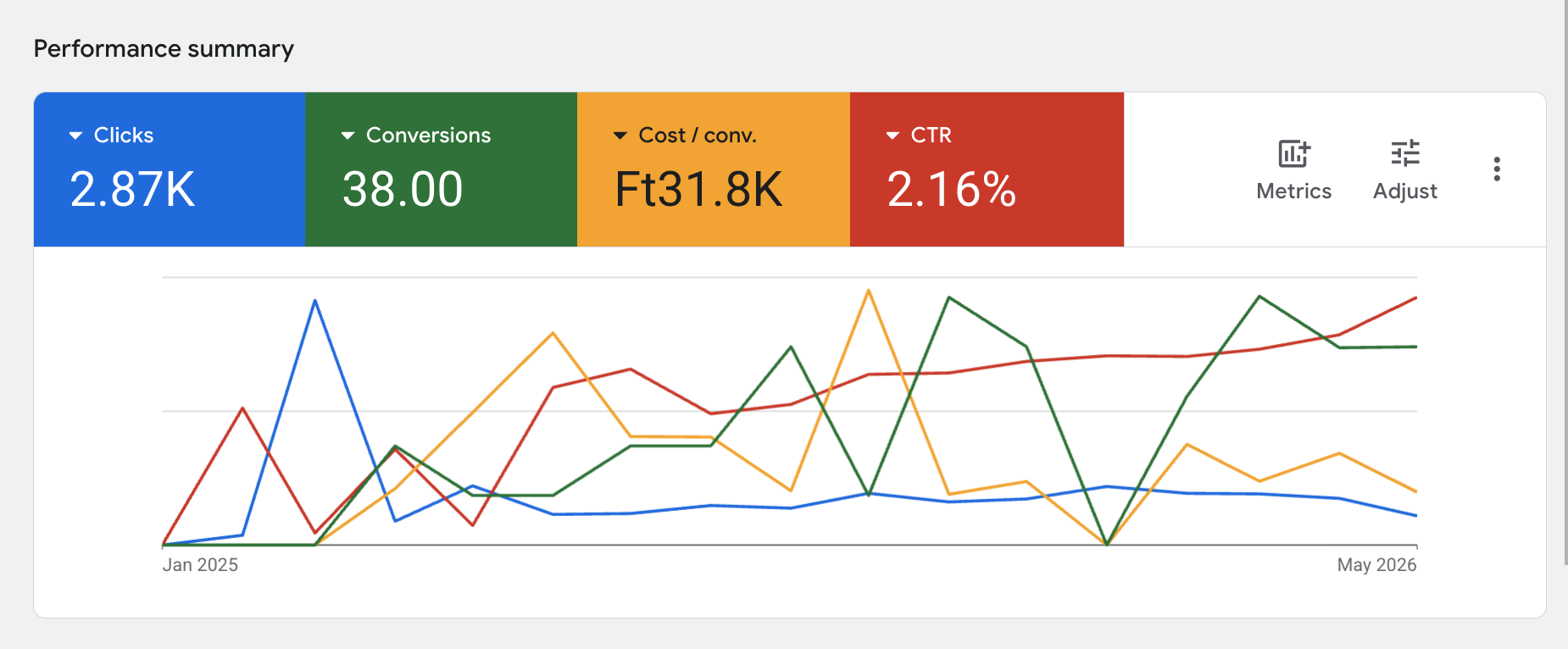
The average order value for a LED wall rental is several hundred thousand forints. Against that, the Ft31,800 customer acquisition cost is a healthy ratio — especially in a B2B niche market where a single client can mean multiple repeat orders. 2.87K clicks, 38 conversions, 2.16% CTR across the Jan 2025–May 2026 period.
The process: decisions and their corrections
This wasn't a one-off intervention — it was an iterative decision-making process where every month brought a concrete question, a hypothesis, and a data-driven answer. Execution was the tool of this decision logic, not the goal.
Launch
Landing, tracking, market research
Building a conversion-focused landing page, connecting GA4 + GTM + Clarity. Google Ads testing with broad match to explore the search landscape and competitive keywords.
Optimisation
Match type narrowing + SEO foundation
Based on data: broad → phrase + exact match transition. In parallel: on-page SEO optimisation, keyword research, fixing the technical foundations of the site.
Authority
Link building — quality vs. quantity
Initially we tried several lower-quality paid SEO articles. Based on the results, we changed strategy: fewer but stronger, topically relevant publications.
Content
Organic blog + tight keyword focus
Launching a blog section with educational, organic content. We narrowed the keyword strategy: only closely related searches, because broader keywords brought irrelevant leads.
Decision lessons: what would we see earlier next time?
Every iteration was a decision opportunity. The key insights here aren't technical — they're about when to pivot, and what the signal looks like:
Where we stand now
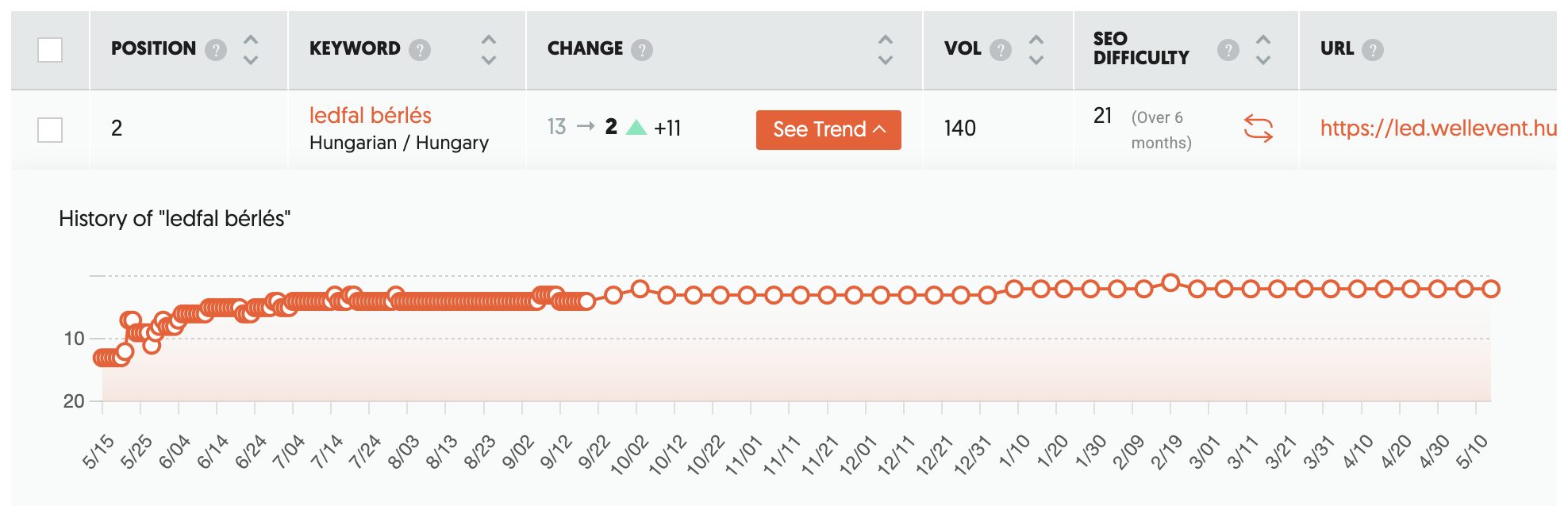
For the keyword "led wall rental", the site now ranks organically at position #2 — the result of roughly 6 months of consistent work on a domain that started from zero. The position improved from 13 to 2 (+11 places), search volume ~140/month, SEO difficulty: 21.
In paid search, we also maintain roughly ~position #2 in impression share compared to competitors.
On average, at least 1 quote request per week comes in from the paid channel, running on a minimal budget. Organic traffic is still growing — the impact of blog content and link building typically takes 3–6 months to fully manifest.
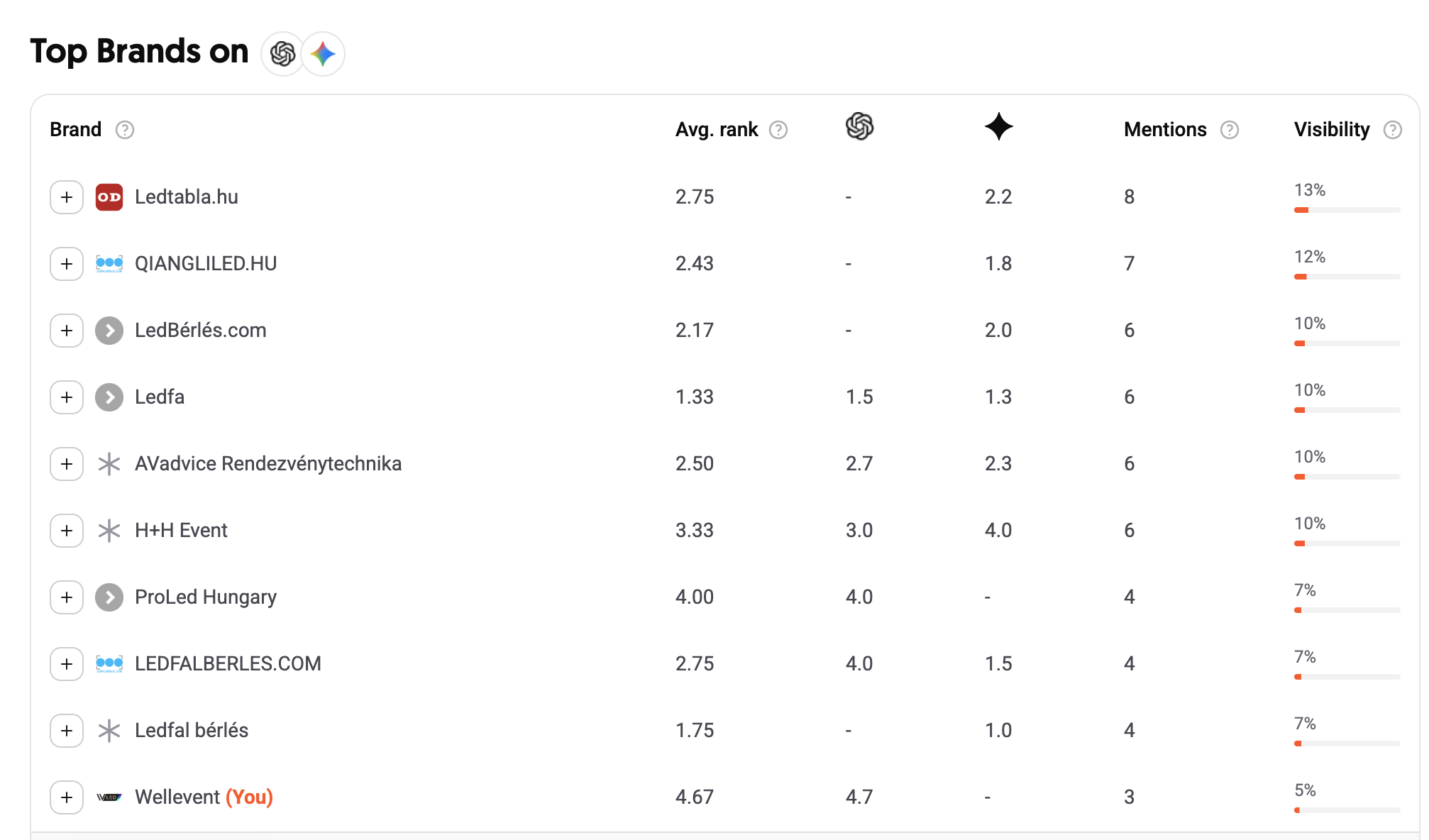
AI mentions — the new frontier: As a result of the strong organic position and structured content, the site has started appearing in AI-powered search responses — ChatGPT, Gemini, and Google AI Overview alike. According to available data, the client appears with 3 mentions and 5% visibility in AI systems for the led wall rental topic, which is remarkable for a domain that started from zero. This isn't precisely measurable in clicks yet, but the fact that the models cite the site as a source is a significant long-term brand-building advantage — and a channel where most competitors aren't yet consciously present.
The business takeaway
In a narrow B2B niche, the greatest risk isn't a poorly configured campaign — it's the wrong entry decision, or delaying the decision for lack of data. If the first weeks don't validate demand, that needs to be visible early. In this case, validation succeeded: the market is small but qualified — and that was sufficient basis to continue and build long-term position.
Paid and organic are not competitors: paid advertising provides immediate presence and data collection, SEO builds long-term positioning and credibility. Together they cover the market — and protect each other. That structure wasn't accidental: it was a deliberate strategic decision.
If you're in a similar position — new direction, unknown market, limited resources — I'm happy to work through the entry decision logic with you. Get in touch →