Is there still a growth path?
Structured decision-making
in a saturating AI market

The task wasn't campaign optimisation — it was determining whether a sustainable growth direction still existed in a rapidly saturating, globally competitive market. 4 structured hypotheses, with honest results.

165% Best monthly ROI
(April)
Ft13.2K Best CAC achieved
(phrase match)
−52% CAC reduction
via keyword optimisation
4 hyp. Hypotheses tested
in 3 months

The real question: where is the growth ceiling?

Before any decision could be made, a more fundamental diagnosis was needed: was the declining ROI a campaign problem, or a structural shift in the market? The first audit made that question answerable — and the answer shaped the entire project.

By 2024, the global AI writing tool market had become one of the most saturated advertising categories. Competitors include ChatGPT, Squibbler and dozens of other tools — with larger budgets and stronger domain authority. In this environment, every penny spent has to work.

The product: a B2C SaaS AI writing tool, in English, targeting a global audience. The funnel: visitor → registration → (demo) → purchase. The budget: a limited daily spend. The campaign had been running since November 2023 — but without reliable data.

The audit: what was blocking good decisions?

Measurement

Conversion tracking was not set up in Google Ads

GA4 data was not being measured; the connection between Clarity and Tag Manager was broken — there were no UX insights. Search Console SEO results were also being ignored.

Campaigns

2 active campaigns were running, but without conversion value tracking

  • Performance Max: 0.15% conversion rate, 25 conversions, Ft11,950/conv.
  • Broad match search: 1.05% conversion rate, ~92.5 conversions, Ft14,348/conv.
Structure

Auto-apply recommendations were running, no geo breakdown, no remarketing

Auto-apply allows Google to independently change campaign settings — which rarely leads to good results on a limited budget.

🔧

First step — tracking foundation: Full GA4 + Tag Manager + Google Ads connection, enhanced conversion setup with custom code snippets, removal of redundant tags, stopping auto-apply. Only after this did it make sense to optimise anything.

The decision process: 4 hypotheses, structured testing

The point of this project was not to "optimise what's running" — but to ensure that every intervention had an explicit assumption and a measurable outcome. We started with four concrete hypotheses and let the data decide in every case — even when the result wasn't what we expected.

Hypothesis 1
Adding conversion value tracking will improve campaign efficiency
Not confirmed
Logic
If Google knows the exact purchase value, it spends smarter — switching to Maximize Conversion Value should deliver a better ROI.

Test
We set up the data connection and switched to a Maximize Conversion Value bidding strategy. Several learning phases and rollbacks followed.

Result
Overall ROI did not increase significantly. CAC rose after the switch (Ft11,933 → Ft18,919), then gradually declined again, but never beat the starting point.

Lesson
More accurate data is necessary but not sufficient. A strategy change alone doesn't solve structural problems — and every switch triggers a learning phase that causes a temporary dip in performance.
Hypothesis 2
Splitting countries (TOP–MID–REST) will improve conversions
Not sustainable
Logic
A global campaign doesn't optimise for individual markets. If we segment — USA, India, REST — each campaign targets a more relevant audience.

Test
We launched a test campaign with a TOP–MID–REST OF THE WORLD structure, first with phrase match, then broad match keywords.

Result
Keyword CPCs were high (some keywords: Ft1,000–3,000/click), and the budget was limited. The segmented campaigns individually did not accumulate enough conversions for effective learning.

Lesson
On a small budget, a maximum of 1–2 campaigns can run efficiently in parallel. Segmentation works when each segment independently receives enough data. If the budget is spread thin across many small campaigns, none of them learns properly.
Hypothesis 3
Phrase match campaigns are more expensive — better to stay with broad match
Disproved — this was the breakthrough
Logic
The broad match campaign had been running for a long time and performing well — phrase match's narrower targeting brings a higher CPC, and therefore a higher CAC too.

Test
We launched a phrase match campaign with the same assets. We gradually removed expensive keywords (e.g. "best ai writer", "best tool for ai writing" — Ft1,000–3,000/click).

Result
The opposite happened. After keyword optimisation, the phrase match CAC dropped from Ft27,935 to Ft13,236 — −52% in one month. This became the best-performing campaign.

Lesson
Broad match performs well in a long-running, well-trained campaign — but expensive, irrelevant searches quietly eat the budget. Phrase match + active negative keyword management can be more effective than the "comfort" of broad match in a saturated market.
⚠️
Hypothesis 4
Remarketing campaigns will quickly generate additional conversions
Right direction, wrong setup
Logic
Visitors who registered but didn't purchase can be brought back with remarketing campaigns — they already know the product, so less persuasion is needed.

Test
We launched test campaigns in PMax, Search and Display formats, with a 30-day audience window.

Result
The 30-day audience did not generate a measurably higher number of conversions. The data revealed that the average purchase window after registration is short — just a few days — anyone who didn't buy in the first few days is unlikely to do so later either.

Lesson
Remarketing isn't a bad idea — but it needs to match the purchase cycle. 15-, 7-, and 3-day audiences, a dedicated landing page and specific messaging are the next step. Worth testing depending on audience size.

The numbers: monthly summary

Only after tracking was set up did the full funnel become visible for the first time — Revenue, CAC, registration-to-purchase rate and ROI month by month.

Monthly performance — 2025 Q2
Month Revenue Total CAC Reg → Purchase ROI Spend
April Ft3–5M Ft9,257 3.89% 165% Ft1.5–2M
May Ft4–6M Ft12,193 4.03% 79% Ft2.5–3M
June Ft2–4M Ft14,234 3.41% 25% Ft2–2.5M
July Ft3–5M Ft13,881 3.39% 40% Ft2.5–3M
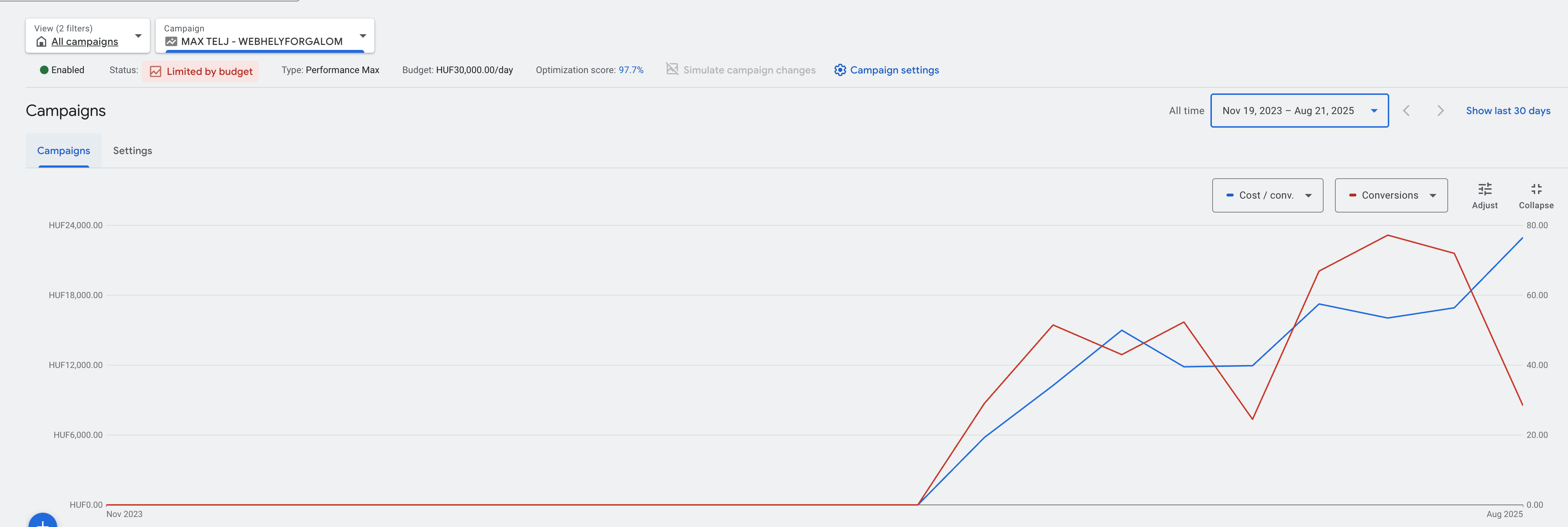
Google Ads Search campaign performance — cost/conv rising continuously, conversions declining as market saturates, Nov 2023 – Aug 2025
Google Ads · Search Search campaign · Nov 2023 – Aug 2025 · Cost/conv rising continuously, conversions declining — the tangible footprint of market saturation

The market context: what matters beyond the numbers

Behind the numbers lies an important structural factor that can't be ignored. During the project period, the AI writing tool market was still relatively new globally — but it was just beginning to saturate rapidly.

As the market matured, CPCs kept rising without pause. ChatGPT, Squibbler and similar major players were continuously increasing their advertising pressure — the CAC levels that were once achievable were being structurally eliminated by the market.

This is an important lesson for any category where well-capitalised competitors are present: CPC inflation is not a campaign failure. A smaller-budget player cannot beat a competitor who is pushing up auction prices with a 10–100× larger budget. In this situation, the strategic question is not "how do we reduce CPC" — but how do we reduce dependence on a single channel.

📈

What this means in practice: if a market is saturating quickly (AI, fintech, SaaS categories), the historical paid advertising CAC data can be misleading. Last year's numbers can't be used as future benchmarks. Channel diversification (email, SEO, Meta) is not a luxury — it's a defence against CPC inflation.

The real bottleneck: not the ads, but the funnel

After three months of data, it became clear that campaign optimisation has its limits. Registration CAC is consistently low — between Ft360–490 — and campaigns continuously deliver registrations. The question is: why does only 3–4% of those become a paying customer?

3–4%
Registration → purchase conversion rate
This is the key metric. If this goes from 3% to 5% with the same traffic, the revenue impact is greater than any campaign optimisation could achieve. At this point, the job of advertising is done — email, onboarding and the offer take over from here.

This is an important insight for every SaaS entrepreneur: paid advertising is the top of the funnel. If the bottom is leaky — if registered users don't buy — then more ad budget doesn't solve anything, it just makes the problem more expensive.

📧

Next steps to increase conversion rate: remarketing with a 3–7 day cycle, email nurturing sequence after registration, dedicated landing pages for each target market, and Meta ads to reduce Google dependency.

Summary lessons

Assumption
Maximize Conv. Value automatically delivers better ROI
Reality: more accurate data helps, but a strategy change triggers a learning phase and isn't sufficient on its own.
Assumption
Geo segmentation works even on a small budget
Reality: if the budget is spread thin, no campaign gets enough data. 1–2 strong campaigns beat 5–6 weak ones.
Assumption
Broad match is cheaper than phrase match
Reality: by excluding expensive, irrelevant keywords, phrase match CAC dropped from Ft27,935 to Ft13,236.
Assumption
30-day remarketing audience is best
Reality: the average purchase cycle is short. The 30-day window is too wide — the meaningful audience converts within the first few days.

The strategic takeaway: what would an advisor do differently?

The most important insight from these three months isn't a specific setting — it's a decision framework. Every intervention is a hypothesis. Some work, some don't. The difference is whether you measure precisely enough to know which is which — and whether you have the discipline to stop what isn't working.

The other lesson: ad account optimisation has a natural ceiling. If there's a hole at the bottom of the funnel — if registrations aren't converting to purchases — more budget doesn't fix it, it just makes the problem more expensive. The real decision starts at that point: what's worth changing inside the funnel?

💬

If campaigns are running in your account but you're not sure they're built on reliable data — I'm happy to walk through an audit with you. Get in touch →

SR
Szuhánszki Ruben
// Davenport · Marketing Consultant
More about me →

What people ask most

Without conversion tracking, Google's algorithm doesn't know which click leads to a purchase — so it spends randomly. Until there's reliable measurement, every optimisation decision is guesswork. The first step of any audit is always to verify the measurement foundation, not to change campaign settings.

On a small budget, almost always. Broad match can work well with large data volumes and high daily spend, where enough conversions accumulate for the learning phase. On a limited budget, however, phrase match delivers more precise targeting: by excluding expensive, irrelevant searches, a 50%+ CAC reduction is achievable.

The smaller the budget, the fewer campaigns can run efficiently in parallel. The learning phase needs enough conversions — if you spread the budget across many small campaigns, none of them learns adequately. On a small budget, 1–2 well-optimised campaigns are always better than 5–6 underfed ones.